National Indigenous Art Fair launches at transformed Cutaway
The National Indigenous Art Fair returns for its seventh year next week, opening at The Cutaway Barangaroo, Sydney, as the first major event in the newly transformed space.
Organisers have described the fair as the venue’s largest presentation of First Nations art and culture to date.
Key Points
- National Indigenous Art Fair runs 3–5 July 2026 in Sydney
- First event hosted in transformed The Cutaway Barangaroo space
- Presented by First Hand Solutions with NSW Government support
- Largest First Nations presentation within the venue, organisers say
- Works available from $100 to $30,000 via direct sales
- Thirty Indigenous art centres represented from across Australia
- All profits go directly to community-owned art centres
Presented by Sydney-based First Hand Solutions Aboriginal Corporation and supported by the NSW Government, the 2026 edition of the National Indigenous Art Fair (NIAF) coincides with NAIDOC Week. The event is billed as the inaugural program in The Cutaway Barangaroo following a major transformation of the site. Within that setting, the fair brings together artists, art centres, and audiences for three days of exhibitions, activities and sales.
According to organisers, the fair’s scope at The Cutaway Barangaroo constitutes the venue’s largest showcase of First Nations art and culture. Works will be available at price points ranging from $100 to $30,000, a structure designed to welcome both first-time buyers and seasoned collectors. Crucially, purchases are made directly from Aboriginal and Torres Strait Islander artists represented by remote, community-owned art centres across the Northern Territory, South Australia, Queensland, and Western Australia.
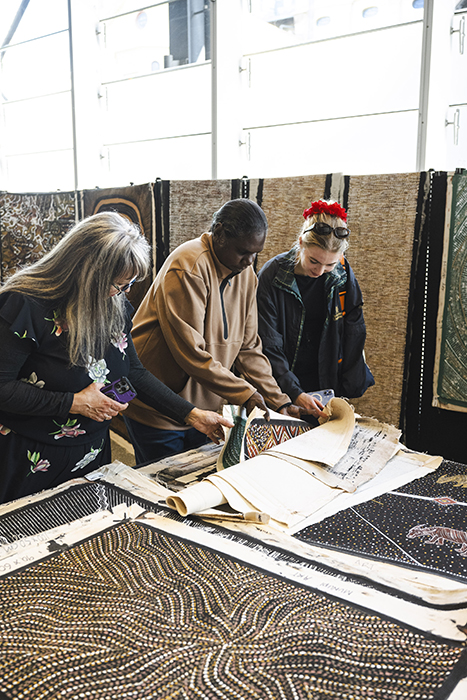
“The National Indigenous Art Fair feels privileged to host artists from some of Australia’s most isolated communities in Sydney and to provide a platform for them to promote and sell their artworks, and host workshops, talks and installations demonstrating their unique arts and cultural practices,” Peter Cooley, CEO of First Hand Solutions Aboriginal Corporation, said.
The fair’s model centres on economic development in remote Indigenous communities and the preservation of what organisers characterise as the world’s oldest continuous living culture.
In line with that mission, no commission or stall fees are charged, and one hundred percent of profits go directly to the art centres. The approach is intended to strengthen sustainable income streams for artists and their communities while facilitating direct engagement between artists and the public.
Artists and art centres
NIAF represents 30 Indigenous art centres from across Australia. Among them are Merrepen, Durrmu Arts, Jilamara Arts and Craft, and Artists of Ampilatwatja. The 2026 highlights list spans established and emerging practitioners working through community-based organisations, reflecting both geographic breadth and cultural diversity.
Highlighted artists and affiliations in 2026 include:
- Kieren Karritpul from Merrepen Arts, Culture and Language Aboriginal Corporation
- Karen Rogers from Ngukurr Arts
- Agnes Donnelly from Warnayaka Art & Cultural Aboriginal Corporation
- Valerie Brumby from Walkatjara Art
- Joseph Williams from Nyinkka Nyunyu Art & Culture Centre
- Mary Gibson from Tjarlirli & Kaltukarjara Art
- Rachel Luckan from Durrmu Arts
- Joey Nganjmirra from Injalak Arts and Culture Centre
- Rekeshia Goodwin from Spinifex Hill Studio
- Stefan Smith from Ltyentye Apurte Traditional Craft Centre
The cross-section of art centres underscores the fair’s remit to amplify community-owned, remote organisations that are central to cultural practice and intergenerational knowledge. By situating these centres at the core of the event, NIAF functions as both marketplace and meeting place, giving visitors opportunities to engage directly with artists, hear about processes, and understand the community contexts in which works are created.
Collectors and visitors can expect a wide range of works accessible at multiple price points, with sales structured to channel all profits to the art centres. The absence of commission or stall fees is presented by organisers as an ethical and economic framework intended to maximise benefit for participating communities while preserving cultural integrity.