Indigenous Australia reacts to the 2026 Federal budget
The Federal Government says it will invest $1.2 billion over five years in First Nations communities and Closing the Gap in the 2026 budget, but it has drawn a mixed response from Indigenous leaders.
The package spans remote jobs, health infrastructure and measures to combat gendered violence.
Key Points
- $1.2b over five years pledged for First Nations and Closing the Gap
- $299m to double Remote Jobs and Economic Development Program to 6,000 roles
- Nearly $220m for Our Ways – Strong Ways – Our Voices anti-violence plan
- $167.6m for 40 community-controlled organisations over four years
- $144m for Aboriginal Community Controlled health infrastructure, $113m for education
- Independent Senator Lidia Thorpe and others say funding falls short
- Concerns raised over legal assistance funding and anti-racism framework
A group of 40 Aboriginal and Torres Strait Islander Community Controlled Organisations will receive $167.6 million over four years to deliver community-led services for women and families experiencing domestic violence. The budget also includes $144 million to improve health infrastructure for Aboriginal Community Controlled health services and $113 million aimed at improving education outcomes.
A missed opportunity
SNAICC – National Voice for our Children, Chief Executive Officer Catherine Liddle welcomed additional funding to prevent domestic and family violence but characterised the overall package as a missed opportunity for community-led responses.
“There’s very little funding dedicated to Aboriginal responses,” she said. “There were plenty of community-led solutions on the table, and very little commitment at a time when Aboriginal and Torres Strait Islander children and families and the services that support them are under scrutiny and needing support the most.”
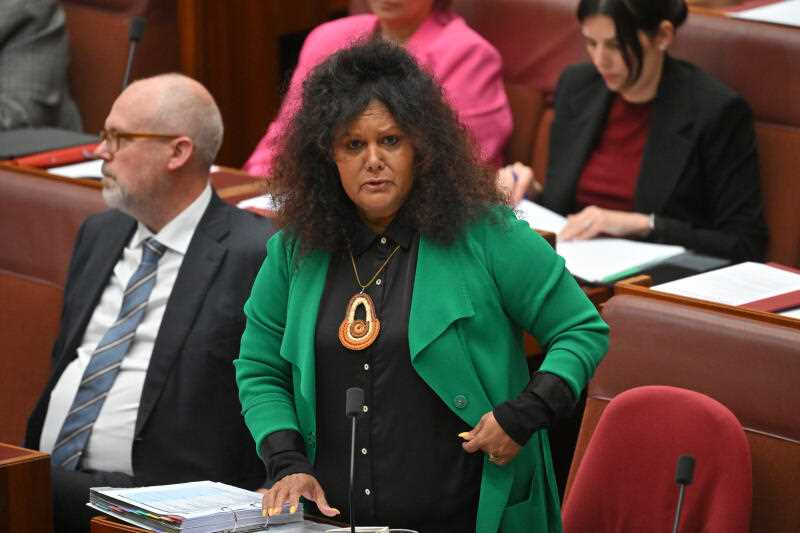
Senator Malarndirri McCarthy.
The government has said the largest single allocation is $299 million to expand the Remote Jobs and Economic Development Program, with the aim of doubling available roles to 6,000. Minister for Indigenous Australians Malarndirri McCarthy, a Yanyuwa woman, welcomed the move as a boost for remote communities.
“What I’m really pleased about, of course, with the area that I have, is the increase in the remote jobs,” Senator McCarthy said.
“I know that unless we have dignity in the work that we do, with superannuation, long service leave, holiday pay – all of the things that make you feel good about getting up and going to work – if we can have that support of the Federal government behind us to increase it up to 6,000 jobs that’s going to make a tremendous difference in our remote regions.”
More support needed
Independent Victorian Senator Lidia Thorpe said the measures fall short of what communities require and argued that more support is needed for grassroots family violence services.
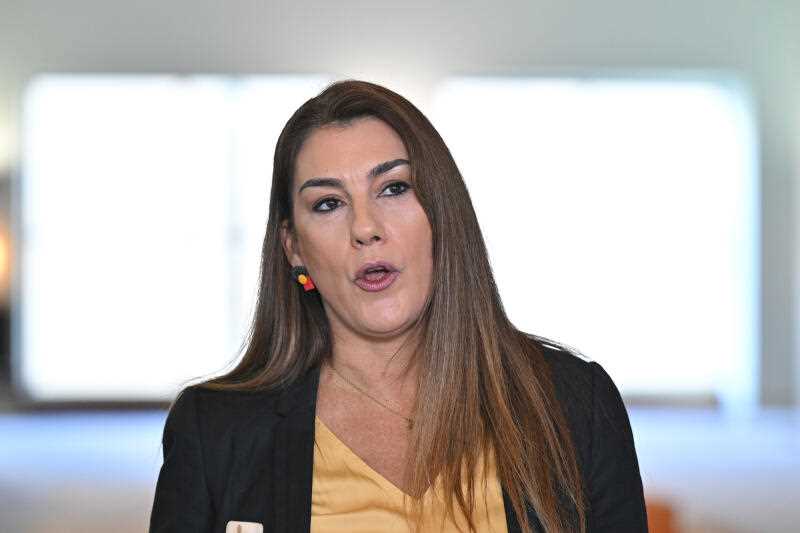
Senator Lidia Thorpe.
She said she has engaged with services where women seek refuge for safety but do not receive funding under these measures, and with remote communities where a family violence service operates from a donga and closes at 5pm, forcing many women to return to perpetrators.
Concerns have also been raised about legal assistance. Yvette D’Ath, Executive Director of National Legal Aid, said prevention and early intervention require a holistic approach in which legal assistance is a key component, alongside housing, health and job opportunities.
NACCHO welcomed what this Budget delivers for community, but called on government to go further on the structural reform that will make the difference for generations to come.
“This Budget takes important steps, and we are genuinely grateful. But the next step is the one that matters most: the needs-based funding model we have built together over nine years. That is the reform that lets ACCHOs deliver at the scale our communities deserve. We have done the work. We are ready to walk this road together,” chair Donnella Mills said.
NACCHO Chief Executive Officer Dawn Casey said the Budget funds some of the symptoms but does not fund the cure.
Great policy risk
“The Treasurer said last night that global uncertainty is not a reason to delay reform; it is why we must move with urgency and ambition. NACCHO could not agree more, and that is exactly the case we have been making for community control,” she said.
“The needs-based funding model is not a new idea; it is nine years of genuine partnership between our sector and government, ready to be implemented. We welcome what this Budget has delivered. And we will keep making the case, respectfully and persistently, for the reform that takes us the rest of the way.”
The First Peoples Disability Network Australia warned that the Budget exposes First Nations people with disability to the greatest policy risk since the NDIS was created, stripping $37.8 billion from disability supports while offering no dedicated pathway, no culturally validated assessment tool, and no funded governance mechanism for the 63,000 First Nations people on the scheme.
CEO Damian Griffis said the budget’s silence on First Nations disability was a failure of design, not just a failure of funding.
“This government is taking $37.8 billion out of disability. That is the single largest savings measure in this budget. And it has not asked a single question about what that means for the 63,000 First Nations people on the NDIS, people who are already the most underserved participants in the scheme,” he said.