Aboriginal ANZACS fought for Australia, but returned home to racism
By JOHN MAYNARD
Historians estimate more than 1,000 Aboriginal Australians served in the First World War.
After the war, many expressed their disappointment that “fighting for our King and country” had not resulted in any improvement in Aboriginal rights or living conditions.
Unlike white soldiers, they were not feted as heroes. Instead, they faced racism and discrimination. The fight for Aboriginal rights and justice during the 1920s was driven by this tension between Aboriginal servicemen’s expectations of war and their subsequent disillusionment.
It was crucial for the rise of organised Aboriginal political activism during the 1920s.
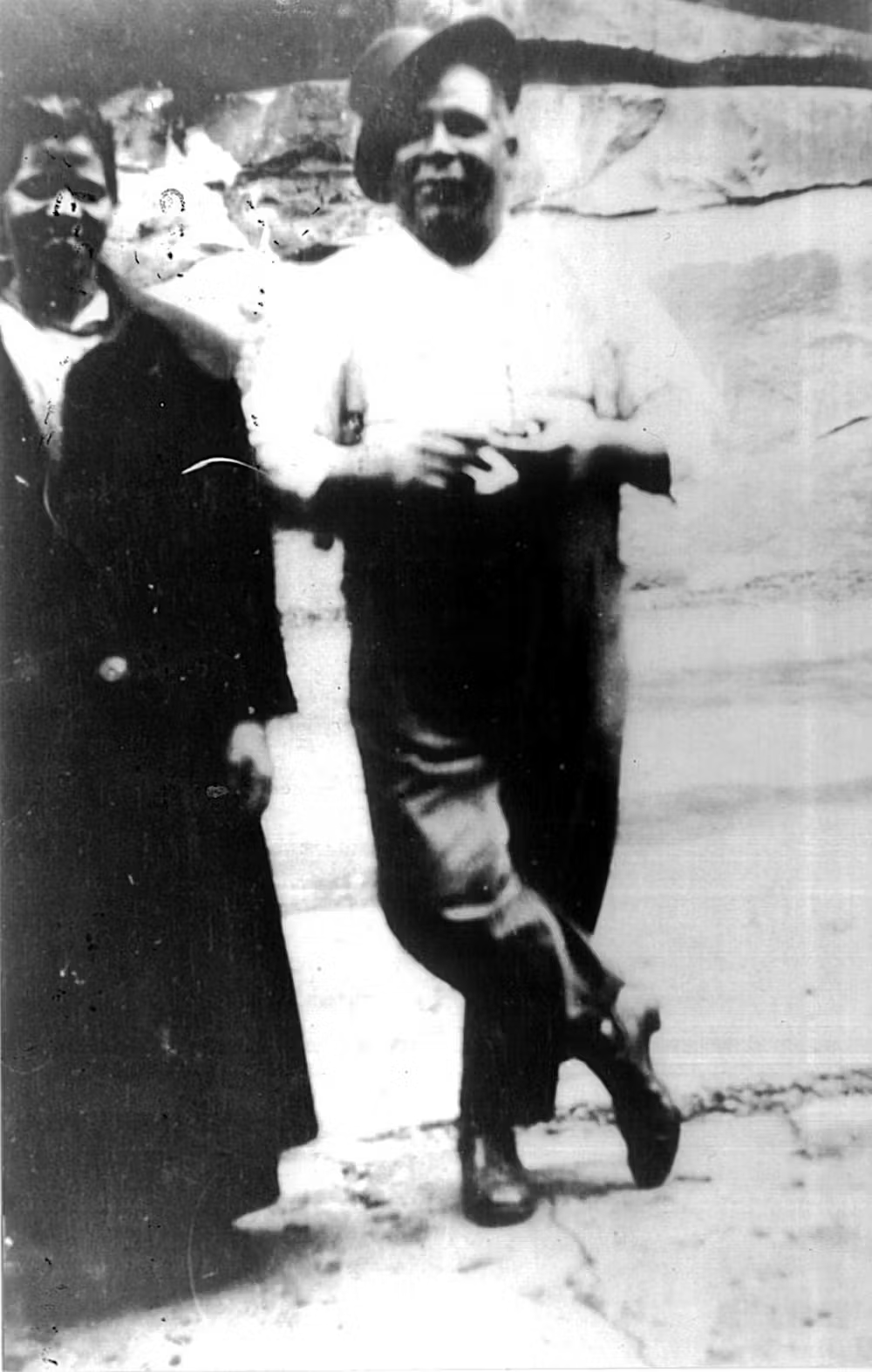
The author’s grandfather, Fred Maynard, with Fred’s sister Emma. Supplied
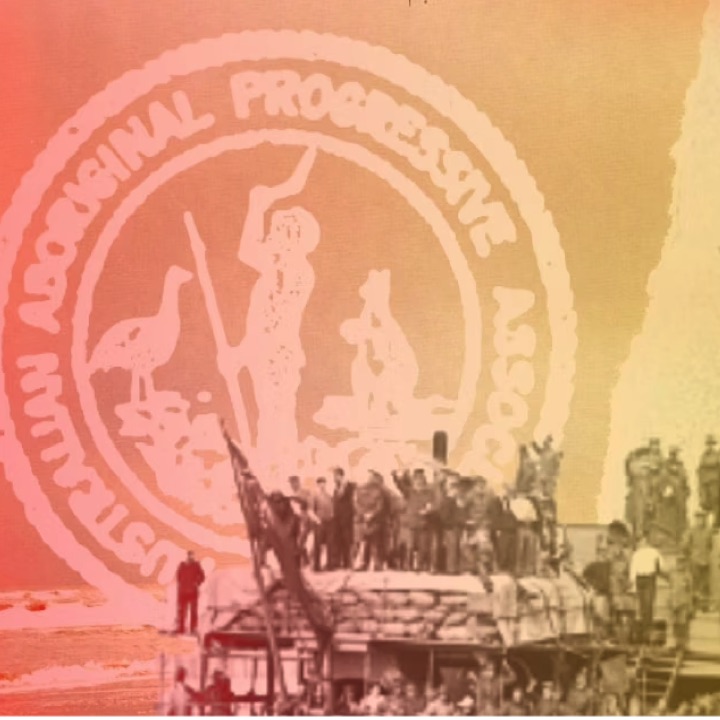
The Australian Aboriginal Progressive Association was founded in 1924. Led by my grandfather, Fred Maynard, it is recognised today as Australia’s first united all-Aboriginal political organisation.
Two key organisers, Maynard’s close friend Dick Johnson and Edward Walker, had both served in the first world war. Another significant member, Tom Lacey, was the father of two soldiers who served (and another close friend of Maynard). Their exposure to international conflict helped them connect racism in Australia with an international struggle for black liberation.
In a 1927 letter to New South Wales Premier Jack Lang, my grandfather referenced the key values of Anzac, emphasising the “loyalty, fidelity and bravery” of Aboriginal men “when conditions have called for the exercise of such virtues”. In the letter, he unleashed his anger at the NSW government’s draconian policies, shocking mistreatment and severe control over Aboriginal lives.
Aboriginal Australian servicemen
Until May 1917, Aboriginal Australians were prohibited from volunteering for the Australian Imperial Force (AIF). The Defence Act of 1909 precluded from service men who were “not substantially of European descent”.
Instructions for enlisting officers at approved military recruiting depots issued in 1916 stated that “Aboriginals, half-castes, or men with Asiatic blood are not to be enlisted – this applies to all coloured men”.
Official barriers to Aboriginal enlistment were relaxed in the latter years of war as the need for volunteers became acute. But discretion remained in the hands of authorities, and overt racism prevented some Aboriginal men from serving.
In 1917, 16 Aboriginal volunteers were suddenly discharged from a training camp in Queensland because “white men have an objection to a ‘blackfella’ being associated with them at the camp”. Despite this racist legislation and attitudes within the military, many Aboriginal men still tried to volunteer.
Why did Aboriginal soldiers join to fight for a country that discriminated against them?
While they shared some of the same reasons as white soldiers – such as the opportunity for pay and the excitement of adventure – Aboriginal soldiers may also have been motivated by the hope for “equal rights during and after the war”. Some said they were “willing to fight to a man if they were accepted by the military authorities”.
In some cases, “joining the military was one of the few acts Aboriginal men living under the Protection Acts could undertake” without asking permission from the authorities. Some managed to convince the medical authorities, which vetted recruitment, to allow them to join, their Aboriginal appearance notwithstanding.
Activist roots in service
Dick Johnson was one. A Yuin Aboriginal man, born at Batemans Bay, NSW, in 1886, he married Mabel Stewart from Wallaga Lake Mission in 1914. Dick worked at the Bawley Point and Kioloa saw mills. Tragedy followed when Mabel died after delivering their stillborn son.
Devastated and grieving, Dick enlisted in the First World War in June 1916, presumably to escape the trauma and heartache of his loss. He was one of 20 Aboriginal men from the Ulladulla region who served in the war.
On his enlistment form he was noted as being of dark complexion with dark brown eyes and black hair – a common descriptor used by military authorities for Aboriginal volunteers. Some Aboriginal men accepted at their initial point of recruitment were later discharged when they had a medical examination.
Another Aboriginal volunteer, Ernest Lacey, initially enlisted in March 1916, but was medically discharged with the comment: “unlikely to become an efficient soldier not due to misconduct”.
Returned medically unfit
This may have been due to racial discrimination, although Ernest was listed as having deformed little toes on both feet. (About 5 per cent of men trying to enlist for the AIF were found unfit because of deformity of their feet.)
Ernest enlisted again, this time successfully, at Wollongong in September 1916. He was recorded as a hatter and set sail on the Ascanius. It docked in Devonport, England on December 28 1916. However, Ernest returned to Australia as medically unfit onboard HMAT Runic on July 6 1917. He was discharged on August 12 1917. He tried to enlist for a third time, but was refused.
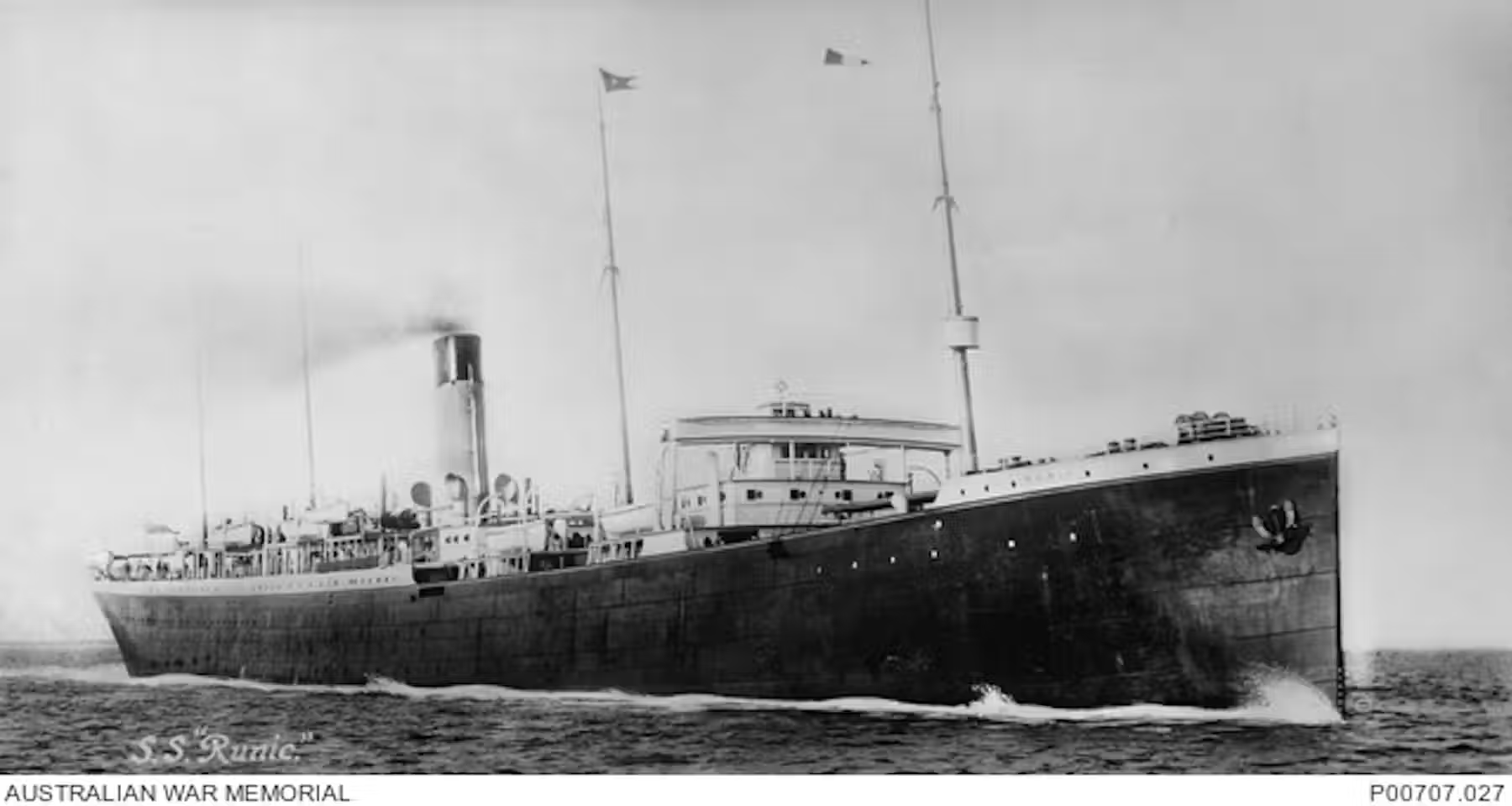
Aboriginal volunteer Ernest Lacey returned to Australia as medically unfit onboard HMAT Runic in 1917. Photo: Australian War Memorial
His brother, Louis, enlisted on August 15 1916 at Sydney. He was recorded as a glassworker and noted as a “coloured lad”, with a “dark complexion, brown eyes and black hair”.
As Louis was just 18, his mother, Emily, wrote a letter of consent from Redfern to the military authorities saying she was “willing to let her son Louis go to the front with his brother Ernest”. Tom Lacey was their father.
Edward Walker was one of another set of Aboriginal brothers who enlisted or attempted to enlist in the war. A Yuin man from the south coast of NSW, Edward was born in Kiama in 1893. At the time of enlisting, he was working as a horse breaker at Casino. His brother, Tom Walker, was the first to join up in 1916 and served on the western front.
Edward then enlisted and was shipped to England onboard the Medic alongside several Aboriginal men from Queensland. He joined the 25th Battalion in January 1918 at Neuve Eglise in Belgium. Tom was in the same battalion but in a different company.
‘Mateship’ and racism
Phillipa Scarlett has argued the popular memory of “mateship” overshadows the extent of racism in the Australian Imperial Force.
“The AIF was dominated by the overarching philosophy of White Australia and believed it was fighting to keep Australia white,” she reports, citing evidence of white soldiers refusing to eat with Aboriginal men in the ranks and disproportionate punishment of Aboriginal soldiers for offences.
It seems likely this shaped the stories of the Lacey brothers, who set sail from Sydney on HMAT Ascanius and disembarked at Devonport. Both had come under the notice of military officers.
Before their departure in May 1916, Ernest had been charged as absent without leave. He had to forfeit three days’ pay. On the voyage to England, he was awarded a further 72 hours’ detention. Similarly, Louis was recorded as absent without leave on the voyage to England. He was given 96 hours’ detention, despite being confined to the ship. He was found to have contracted venereal disease on shore leave at Sierra Leone.
Louis continued to draw the ire of military officers. In England, he was disciplined on another two occasions. The second, in September 1917, was for drunkenness and behaviour conducive to the “prejudice of good order and military discipline” – while he was at Fargo Hospital, he behaved “in a disorderly manner”.
As Scarlett notes, Aboriginal soldiers were subject to excessive discipline in relation to alcohol use. Some military police attempted to enforce Australian legislation prohibiting Aboriginal men from drinking.
While many Australian soldiers displayed insubordination in the military, for Aboriginal soldiers, repeated records of military discipline may indicate racism among the ranks.
Traumatised by battle
In November 1917, Louis was finally shipped to France to join the 17th Battalion. Again, he was in trouble, for using insulting language to his superior officer and taking another 14 days’ absence without leave. Louis was clearly one severely irritated soldier, evidently not coping with the military discipline of the AIF.
In June 1918, he was charged with desertion: it was claimed “when the Battalion was in the forward area [on 17 May], he absented himself without leave and remained so absent until arrested”. He was sent back to England under escort.
The 17th Battalion War Diary shows that at the time Louis Lacey deserted his battalion, it was in the front line near Sailly-le-Sec on the Somme. It also records that just prior to his desertion, the battalion had been involved in heavy fighting and repelled an attack. This resulted in the capture of thousands of German prisoners.
The battalion itself suffered 17 killed and another 36 wounded. On May 16 1918, it was relieved from the front line and sent back to a reserve position. That night, the reserve area came under heavy cannon fire. Another member of the battalion was killed and 11 were wounded.
It appears, then, that Louis was traumatised from his experiences. He was arrested at Oisemont, more than 60 kilometres from Sailly-le-Sec. This distance suggests he was desperate to get away from the front line. He was sentenced to five years in jail at H.M. Prison Gloucester.
‘Trees of flame’
Dick Johnson left Australia onboard HMAT Ceramic on October 7 1916 and arrived in Plymouth on November 21. On February 15 1917 he was shipped to France and arrived in Étaples to witness “immense concentrations of Commonwealth reinforcement camps and hospitals”. By 1917, there were 100,000 troops camped there.
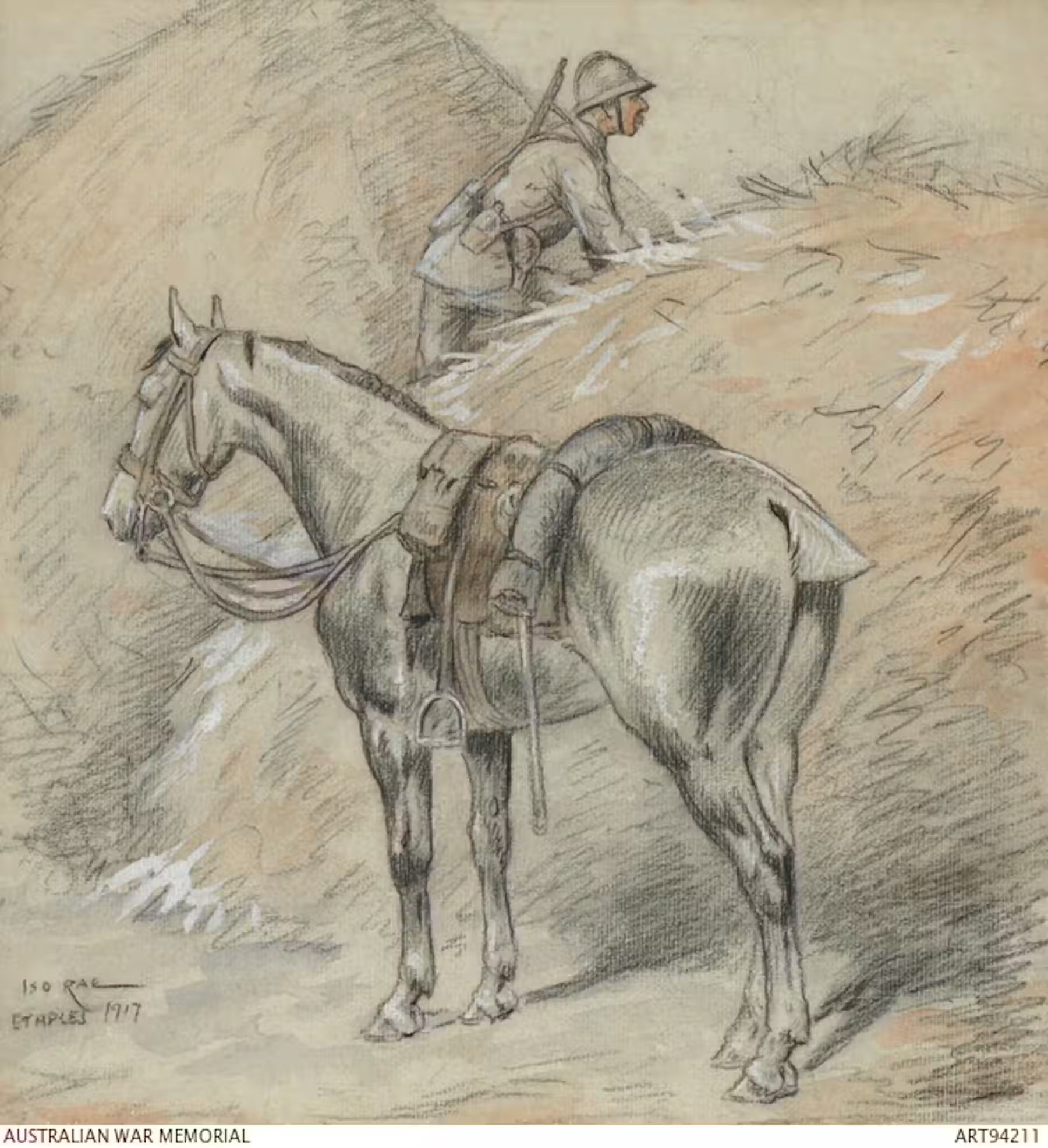
A French soldier with his mount at Etaples camp during the First World War. Photo: Australian War Memorial
Johnson joined the 13th Battalion, which was soon involved in some of the heaviest fighting on the western front at Bullecourt. One survivor recalled this terrible and futile battle:
A tornado of thunder and flame fell upon us, beyond anything I had known or imagined. Close as trees in a forest were the trees of flame. […] A score of men just in front melted in bloody fragments as a big-calibre shell landed. […] The plain was carpeted with bodies, most lying still, but some crawling laggingly for cover […] But there was no sound of human voice in all the storm.
In early June 1917, Johnson was admitted to hospital with an injury to his right heel. He rejoined his unit on July 14. For the remainder of 1917, the battalion was in Belgium advancing on the Hindenburg Line.
In June 1918, Johnson was wounded again. Eventually, he was invalided back to Plymouth with a knee injury. Convalescing in the United Kingdom, he met a Scottish woman, Thomasina Douglas, and they were married on January 4 1919 in Edinburgh. The couple returned to Australia on SS City of Exeter eight days later.
Thomasina clearly helped Johnson heal from the pain of the loss of his first wife. They would be together for the rest of their lives.
Loss and recovery
Meanwhile, Edward Walker, seven months after arriving in France, was wounded in action in July 1918, then shipped to England for treatment at the Southern General Hospital in Plymouth. From there, he wrote a concerned letter to the Red Cross seeking information on his brother Tom.
He had heard Tom had been killed in action, but received no official notification. Sadly, it was confirmed Tom had been killed on August 11 1918 at Bayonvillers. A low-flying German plane had dropped a bomb directly onto the trench, killing him instantly.
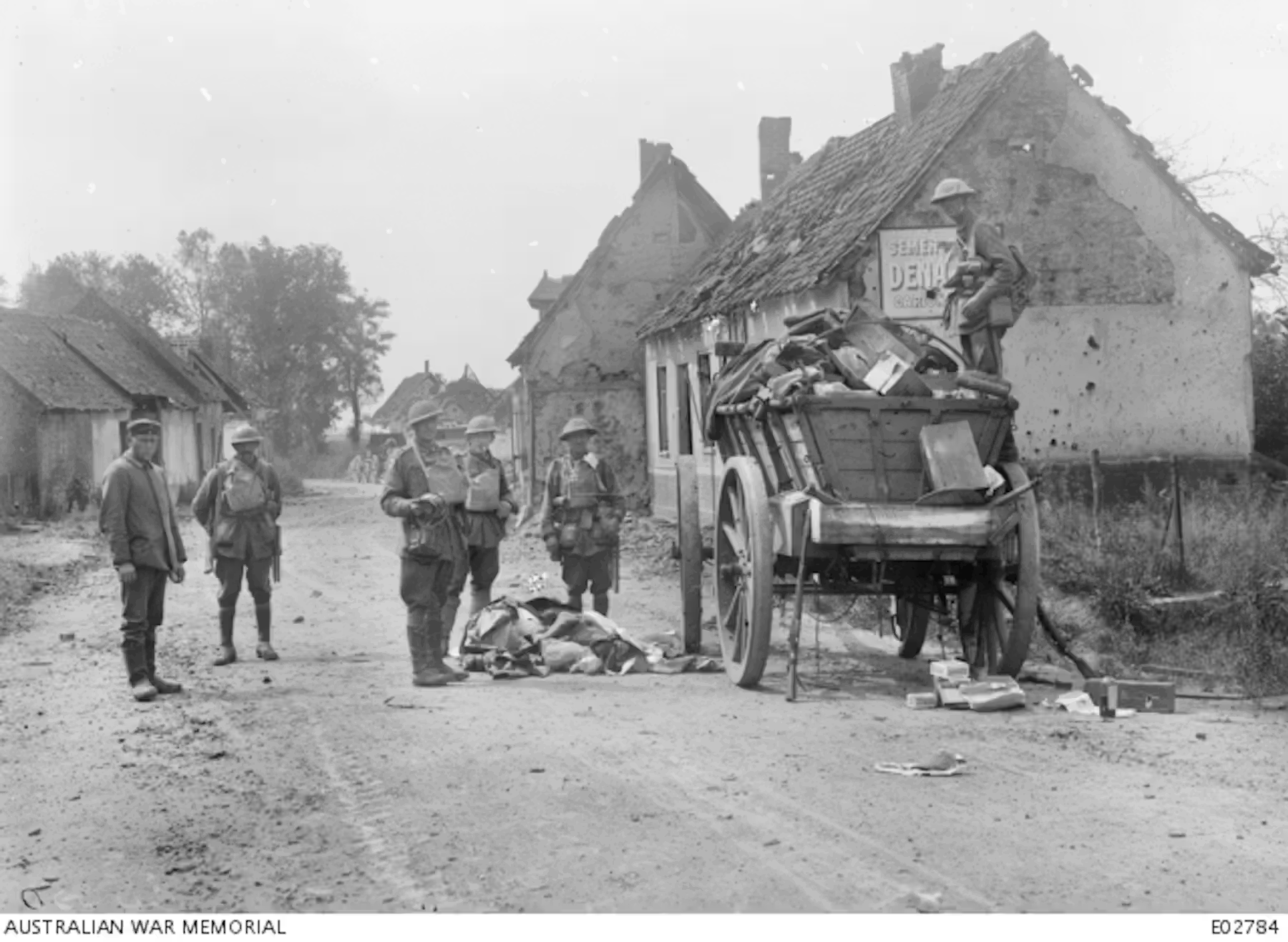
Tom Walker was killed in a trench at Bayonvillers (pictured, in August 1918). Photo: Australian War Memorial
Tom left behind his wife, Lily, and two young children, living on the Aboriginal reserve at Ulgundahi Island on the Clarence River. Months after the loss of his brother, Edward was released from hospital – only to contract Spanish influenza.
The impact of the Spanish influenza, which the returning soldiers brought back to Australia, was devastating, with an estimated 15,000 people dying during the pandemic. Walker survived, but “was deemed no longer fit for active service”.
Just after the Armistice was signed in November 1918, he sailed back to Australia onboard HMAT Bakara. He returned to Ulgundahi Island and lived with his family there.
Battles at home
At war’s end, men of the AIF suffered physical and psychological wounds. Aboriginal soldiers did not have the same level of support that many returned soldiers enjoyed. Only a handful of Indigenous soldiers were successful in their applications under the soldier resettlement scheme. Even then, they faced blatant racism.
One Aboriginal man was granted a block near Forbes in western NSW, but his application for a loan to develop the land was rejected by an inspector: “This case is unsatisfactory … the holder is a blackman … altogether the wrong sort of man.” At least three other Aboriginal men faced overt discrimination that blocked their claims.
While Aboriginal soldiers were entitled to repatriation benefits, the policy was likely not “applied equally across the board”, with “sporadic complaints about discrimination against Aboriginal war veterans during the 1920s and 1930s”. Aboriginal soldiers had the additional burden of facing continued racism and prejudice when they returned home.
Not even a second-class citizen
Edward Walker’s postwar experiences starkly illustrate this. In 1919 he was forced to appear in court when a publican was charged with serving liquor to him and two friends in NSW. Edward was summoned to the trial, where the defence argued the publican should be let off because Edward was a returned soldier and it was unclear whether he was Aboriginal.
No white soldier was hauled to court for drinking a beer in a pub. Four years later Edward was back in court, this time “charged with using insulting words to Allan Cameron, manager of the Aborigines settlement on Ulgundahi Island”.
Cameron alleged Edward had assaulted him. Yet it appears Edward was the one under assault. “He caught my coat and said that I was bludgeoning on the returned soldiers’ badge,” he said.
Cameron claimed not to have known of Edward’s severe wartime injuries: “I did not know that defendant was a cripple, he gets the same wages as any other man and is able to work as well as any other.” Yet Cameron had known Edward for years. In 1918 he had commented on the Walker brothers’ experiences of war.
A witness, J. David, corroborated that Cameron was the aggressor and had the “defendant down and bumping his head on the ground”. Despite this evidence, the police magistrate decided to convict Edward on both charges, fined and bound to good behaviour for three months. Edward appealed.
Instead of being celebrated as a war hero, Edward Walker discovered he was a pariah – and not even a second-class citizen back in his own country.
Struggles with the law
Other soldiers had struggles with the law. In the UK, Louis Lacey had his five-year sentence commuted to one year. On release with good conduct, he was admitted to hospital with a septic foot and sent back to the AIF. Again, he went absent without leave after escaping lawful custody.
His father, Tom Lacey, was concerned with his son’s wellbeing and whereabouts, writing to military officials in September 1919:
I have a son at the front 6086 Private Louis Lacey 17th Battalion, and I have received no letters from him for the past four months and he said that he thought he would be returning to Australia in July, and I have had no word from him.
Louis finally sailed for Australia on September 22 1919. Yet even onboard ship, he took part in a disturbance on the troop deck and received 28 days’ detention.
Back in Australia, Louis remained a disturbed individual. It is not known whether he re-established a relationship with his family. In the early 1920s, it is recorded that he embarked on a boxing career.
That career, however, seems to have been short-lived. In 1928, he was recorded as living in the Salvation Army Shelter in Melbourne. In 1932, he was serving two years’ hard labour in Long Bay Gaol. At this point, Louis Lacey disappears from the historical record. Although we cannot know what his issues were, he clearly struggled with military discipline – and almost certainly with racism, both in the army and out of it.
Louis’ brother, Ernest, by contrast, appears to have lived a quiet life after the war. When he passed away in 1957, he was described at his funeral as the best known and most respected Aboriginal in Nowra, NSW.
More than 60 ex-servicemen attended to pay their respects at the Nowra War Cemetery. The funeral was carried out with full military honours and a rousing farewell from the Nowra branch of the RSL. Ernest’s casket was draped in a Union Jack with a digger’s hat and reversed spurs.
A speaker at the gravesite said: “We would like to remember the deceased as a young man, forgetting all colour of skin; he offered his life for his country along with the rest of Australia.” His community’s recognition of his service echoes the limits of mateship extended towards Aboriginal servicemen during the war.
As Scarlett shows, expressions of mateship with Aboriginal soldiers by white soldiers often positioned them as “white inside”, passing over the soldier’s Aboriginality, yet still marking it as inferior.
Postwar activism
In the early 20th century, Aboriginal political mobilisation was catalysed by the revocation of Aboriginal independent farms, and the escalation in Aboriginal child removal by the NSW Aborigines Protection Board.
Aboriginal soldiers returning home faced the devastating news that some of their families had been forced from their independent farms by the Aborigines Protection Board. Some of these men also learned that during their absence fighting for their country, their children had been removed from their wives’ care and placed into government institutions.
The Aboriginal community response to the establishment of the Australian Aboriginal Progressive Association, six years after the end of the war, was staggering. Within six months it had opened offices in Crown Street, Sydney, with a membership of more than 600 across 13 branches and four sub-branches around the state.
As a wharf labourer in Sydney, Maynard was a part of the Waterside Workers Union, which opposed conscription for overseas service, so he didn’t serve. But he carried a deep awareness of international events from his time on the Sydney waterfront. He and other Aboriginal dockworkers had developed close connections with visiting international black merchant sailors.
He was particularly influenced by Marcus Garvey’s Universal Negro Improvement Association (1920–24, with its message of racial, cultural and historical pride. An Australian chapter was established in 1920.
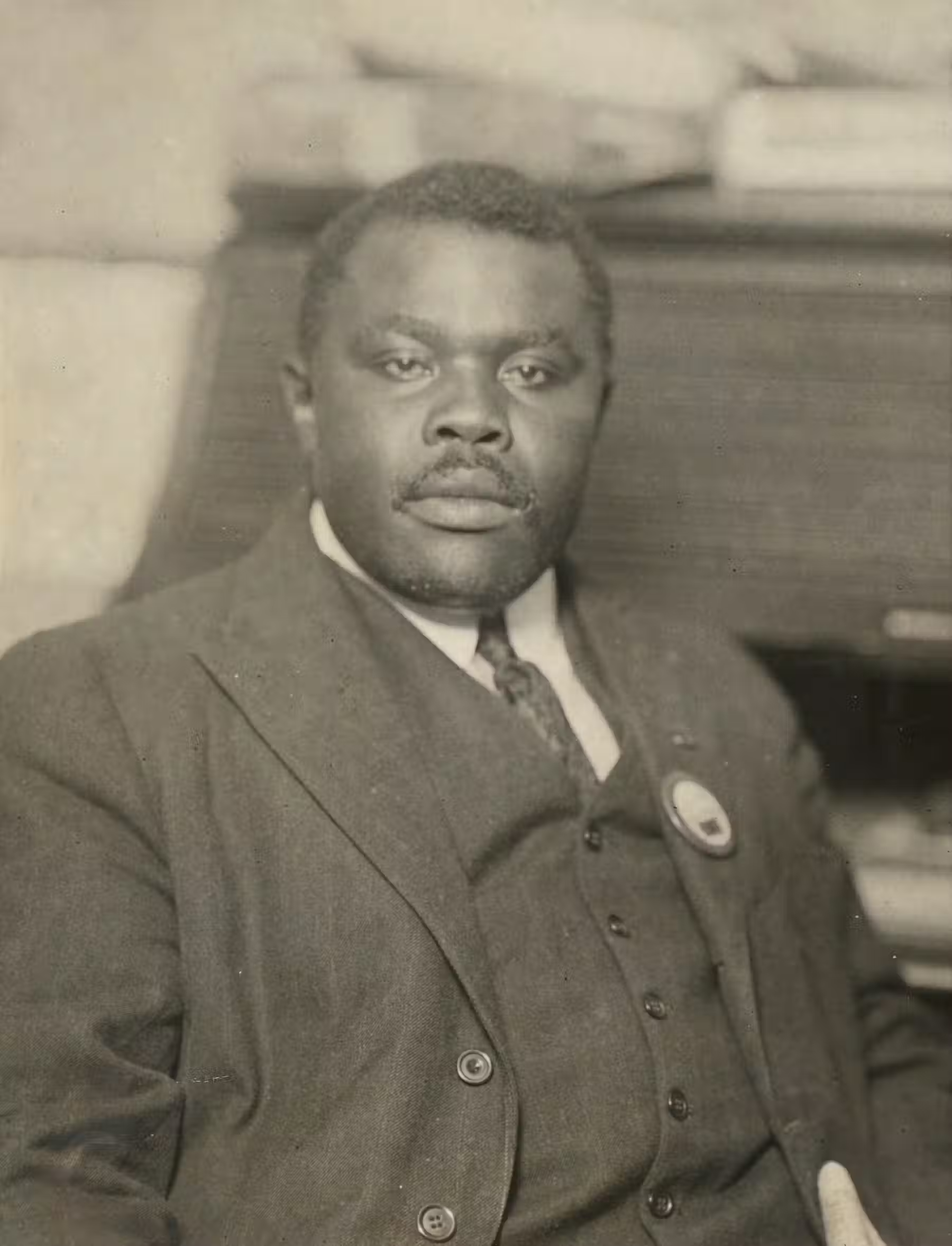
Marcus Garvey. Photo: United States Library of Congress
A powerful 1922 speech in Harlem resonated with the Aboriginal activists’ thinking about the dissonance between the supposed aims of the Great War and the reality of Aboriginal peoples’ lives:
You are asked to go and fight the Germans who had done you no wrong. You were told to give the Germans hell, while they were giving your mothers, sisters and sons hell in Mississippi, Georgia, Alabama and the Negro asked, “Which is better, to make the world safe for democracy, or to make his home safe for his wife and children?”
At the first association conference at St David’s Church and Hall in Sydney in April 1925, with more than 200 Aboriginal people in attendance, Johnson referenced Aboriginal military service and loyalty during the war. Months later, at the Australian Aboriginal Progressive Association’s first half-year meeting, he was reported in the press as a man “who wears the returned soldier’s badge”.
He was elected secretary of the Association’s Central Branch. Johnson remains one of the many important, but overlooked, Aboriginal political activists of the 20th century.
A fervent fighter for justice
Tom Lacey, father of Ernest and Louis, likely carried the trauma of his sons’ experiences with him. He assumed the position of treasurer when the Australian Aboriginal Progressive Association was formed, inspired by the surge for self-determination by oppressed peoples across the globe.
In a 1924 letter to Garvey’s central branch in Harlem, published in the Negro World, Lacey pledged the support of 10,000 Aboriginal people in NSW and 60,000 nationally.
He revealed the tight and restrictive controls Aboriginal people lived under, and that they had trouble reaching
some of our people, as the missionaries have got the most of them […] The authorities won’t allow us to see them unless we can give them [the Aboriginal Board] a clear explanation of what we want them for.
Yet he asserted that, given the opportunity, Aboriginal people were capable of gaining the same position “as the coloured people of the United States of America, who have their own colleges and universities”.
When he passed away in 1930, the press described Tom as “one of the most forceful advocates of the cause of his people – the Australian Aborigines […] His death is a distinct loss to his people, and he will be sadly missed.”
As for the Walker brothers, it was Edward who carried his experience of war into activism. Suffering serious wounds, he should have returned to a hero’s welcome. Instead he was greeted by the severe restrictions and blatant racism of continuing discrimination against Aboriginal Australians.
He would become the secretary of the Clarence River branch of the organisation. A fervent fighter for Aboriginal rights and justice, he joined the organisation only a year after he was assaulted and racially vilified by Cameron.
Edward was a prominent figure in 1925 and 1926. Alas, press reports tell us little more than his name. He died in 1976, aged 82.
Aboriginal veterans and Anzac
The motives of the Aboriginal men who joined the AIF in 1914–18 were not recorded in any official capacity. But surely they anticipated their service on behalf of Australia would enhance their claims to full citizenship rights on their return.
Instead they confronted deeply embedded racism. This continued in Australian military service. In the second world war, for example, Private Russell Amato went AWOL three times from three different units, because he “couldn’t stand the other soldiers making derogatory remarks about Aboriginal people, particularly women, about whom the talk was sexual”.
In Amato’s court-martial, the defending officer reported that Aboriginal soldiers routinely faced such discrimination: “it appears that there is a certain element in the camps that brings up the colour bar against such men”.
The marginalisation of Aboriginal soldiers from the mainstream Anzac narrative was only addressed from the 1990s, with a concerted effort to draw attention to the service of Indigenous soldiers in the prelude to the centenary in the 2010s.
The Australian Aboriginal Progressive Association disappeared from public view after 1929, harassed, hounded and smashed out of existence by a coalition of the Aborigines Protection Board, the missionaries and the police. However, its legacy continued as its members remained active in pressing for Aboriginal rights.
- Professor John Maynard is a Worimi Aboriginal man from the Port Stephens region of New South Wales. He is currently a Director at the Wollotuka Institute of Aboriginal Studies at the University of Newcastle and Chair of Indigenous History.
- This article was first published in theconversation.com