Melbourne’s 50 words project reaches 100 Indigenous languages
University of Melbourne researchers have reached a landmark in the 50 Words Project, preserving audio recordings of 50 unique words in 100 different Indigenous languages across Australia.
The online resource pairs translations with community-approved recordings and an interactive map to support learning and revitalisation.
Key Points
- 50 Words Project reaches 100 Indigenous languages milestone
- Audio preserves 50 unique words for each language online
- Led by Professors Rachel Nordlinger and Nick Thieberger at RUIL
- Platform launched in 2019, attracting 300,000-plus visitors
- Interactive map features community-approved speaker recordings
- Resource used in schools, language programmes and communities
- Project to expand with more languages alongside communities
Milestone and project overview
The 50 Words Project is led by linguists Professor Rachel Nordlinger and Associate Professor Nick Thieberger from the Faculty of Arts’ Research Unit for Indigenous Language (RUIL). Since its launch in 2019, the platform has drawn more than 300,000 visitors and is widely used in schools, language programmes and Indigenous communities for language learning.
Through an interactive map, users can explore Indigenous languages from across Australia and listen to words spoken by community members from each language group. All recordings are published with community permission, with the project designed to present concise, accessible samples that can be used in classrooms and community settings.
Researchers curated 50 commonly used words in each language, building a cross-country snapshot that helps learners compare pronunciation and usage. By bringing together translations with audio, the platform offers an immediate entry point for those beginning language study and a complementary tool for ongoing revitalisation efforts.
“This is the first time words from Indigenous languages have been brought together online at this scale, and in a format where people can hear words spoken by members of those language groups,” Professor Rachel Nordlinger, Research Unit for Indigenous Language, said.
Professor Nordlinger said the milestone reflects sustained collaboration with communities and educators. She noted that teachers have used the platform to introduce students to the Indigenous language of their area, while communities are drawing on it to support intergenerational learning and language revitalisation.
Features highlighted by the university include:
- Audio recordings of 50 unique words in 100 Indigenous languages
- Translations and speaker recordings hosted together in one resource
- Interactive map for exploring languages across Australia
- Recordings shared with community permission
- Use in schools, language programmes and Indigenous communities
Classroom use and community impact
The platform’s educational role is visible in secondary classrooms. Tiffany Chen, an English Language teacher at Melbourne’s University High, is using the resource with VCE English Language students to examine the relationship between languages, cultures and identities in Australia. She said the materials have supported analysis of language maintenance, reclamation and revitalisation in a rapidly changing world.
According to Ms Chen, students have explored linguistic similarities and differences between English and Indigenous languages such as Kriol. The work has opened space for discussions about personal and group identities, Australian colonial history, multilingualism and language. Teachers have been able to connect local language contexts with broader reflections on how language shapes culture.
Within community settings, the resource is being drawn upon to sustain intergenerational learning and language knowledge. The concise word lists, paired with recordings from community speakers, provide a tangible way for learners to hear language as it is used today and revisit it repeatedly for practice.
The project team emphasises that each recording offers learners a reference point for pronunciation and rhythm. This approach supports people at different stages of learning, from first encounters with a language to complementary study within broader revitalisation initiatives.
Why audio matters
Associate Professor Thieberger underscored that audio documentation captures features of speech that written materials cannot fully convey. The recordings preserve pronunciation, rhythm and ways of speaking for each language, giving learners a model they can hear and revisit. He said the result is a dynamic resource that reflects the voices of community speakers.
“These recordings capture pronunciation, rhythm and ways of speaking that written text alone cannot preserve,” Associate Professor Nick Thieberger said.
Researchers plan to expand the resource by working alongside communities to add more languages in the future. With its interactive map, community-approved recordings and consistent word sets, the 50 Words Project is positioned to continue growing while supporting language learning in schools, language programmes and Indigenous communities across Australia.
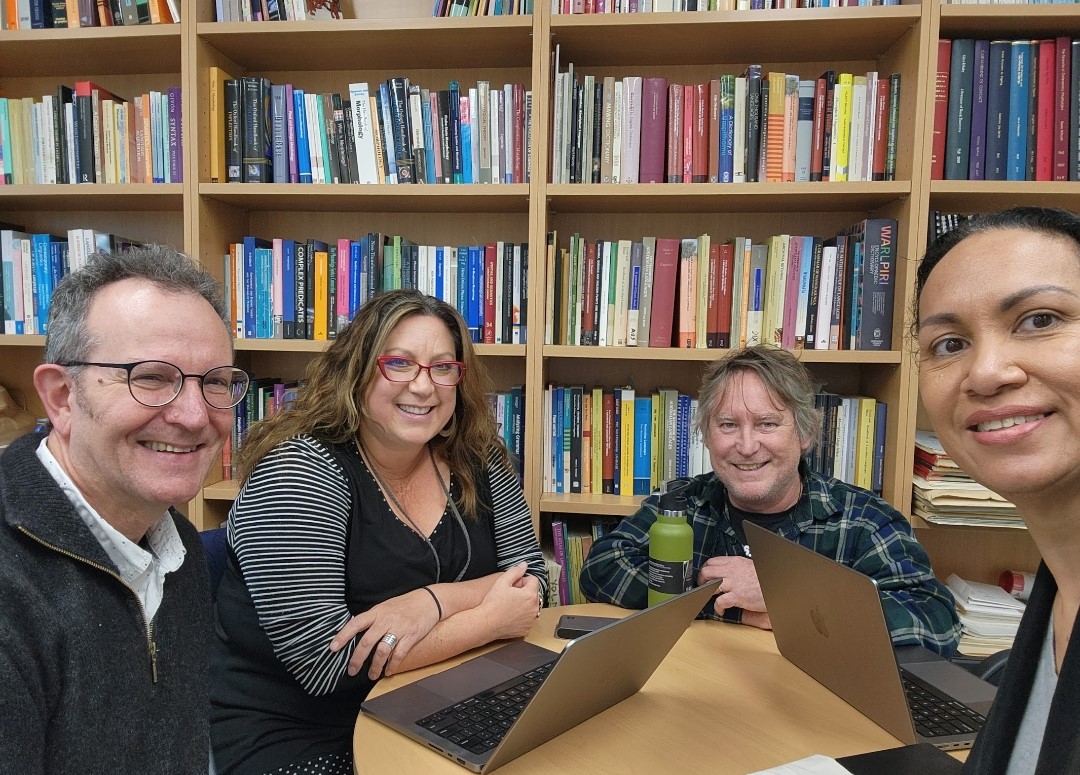
Main image: L-R – Research Unit for Indigenous Language researchers, Associate Professor Nick Thieberger, Professor Rachel Nordlinger and Professor Brett Baker, and Djukun woman, Jaala Ozies, discussing 50 Words in Djukun language.