Arnhem Land partnership sees education rethink
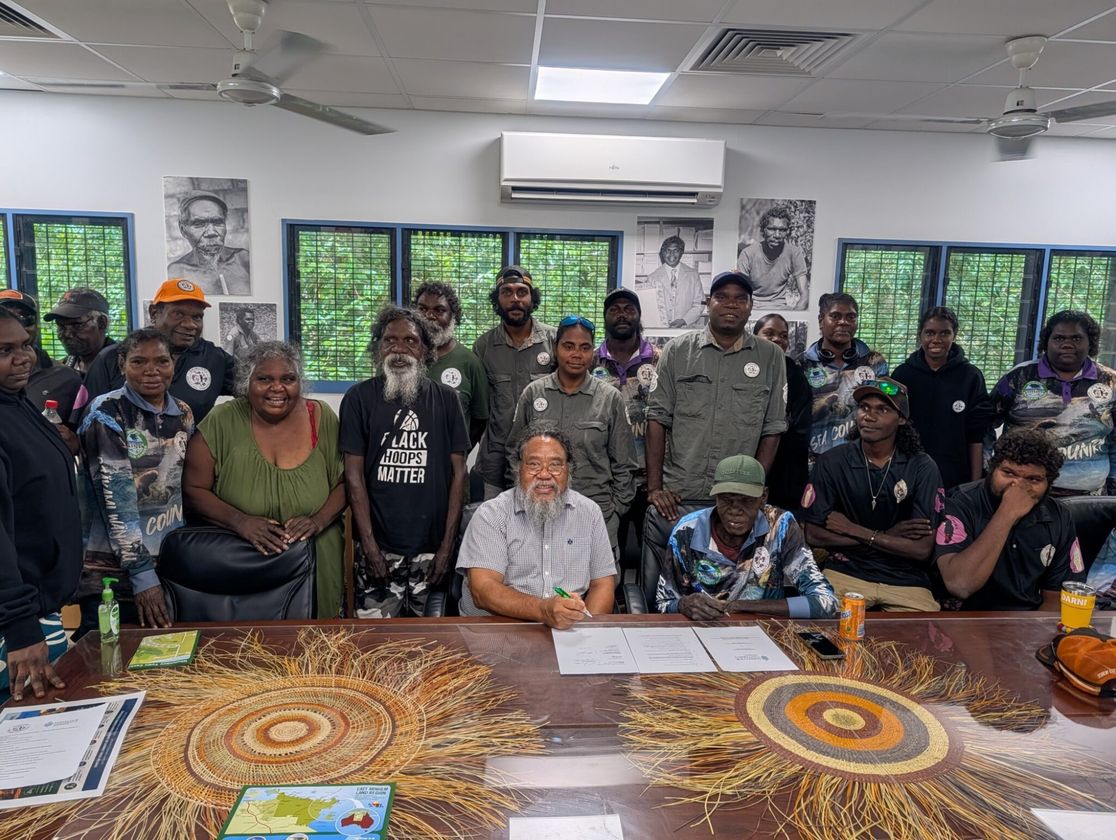
A new partnership led by Yolŋu Rangers is reshaping how learning is recognised, delivered and valued in northeast Arnhem Land, aligning on-Country knowledge with formal credentials through collaboration between Dhimurru Aboriginal Corporation and James Cook University.
Announced last month, the initiative is being framed by its proponents as a national turning point that centres Indigenous knowledge systems and challenges long-standing approaches to education reform.
Key Points
- Dhimurru and JCU partner to recognise and credential Yolŋu knowledge
- Initiative reframes learning through the cultural interface on Yolŋu Country
- Partnership challenges systems after nearly 40 years of mixed reforms
- On-Country expertise to be made visible in formal education
- Education delivery planned for multilingual, intercultural environments
- Model presented as foundational shift, not a marginal pilot
- Yolŋu Rangers positioned to lead national education rethink
The collaboration brings Dhimurru Aboriginal Corporation and James Cook University (JCU) together to design learning pathways that acknowledge Yolŋu knowledge, cultural authority and lived expertise as foundational, not peripheral.
The partners say the work responds to decades of efforts across Australia that have not delivered meaningful change for Aboriginal and Torres Strait Islander learners despite nearly 40 years of reform.

Rather than adapting Indigenous learners to fit within existing structures, the partnership asks whether the system itself is the barrier to progress. It is explicitly grounded in the “cultural interface,” where Indigenous and Western knowledge systems meet, interact and hold equal value.
Within this interface, the partners aim to construct a new learning architecture that functions across languages and cultures and in some of the most remote settings in the country.
Dhimurru Executive Officer Stephina Salee said the approach was as much about formal recognition as it is about innovation, highlighting the advanced capabilities Rangers already bring to complex land and sea management.
“Our Rangers are already operating at a high level, managing country, navigating cultural law, and engaging with science and governance systems every day. The challenge has never been capability. It’s been the system’s inability to recognise and build on that capability,” Ms Salle said.
Yolŋu Rangers’ responsibilities span environmental monitoring, biosecurity, cultural site protection and community engagement. Their work is carried out across multiple language groups and within intricate governance frameworks. While this expertise is deep, highly technical and grounded in thousands of years of practice, much of it has not been formally acknowledged within Australia’s education system.
Partnership model and on-Country pathways
Dhimurru and JCU will explore how to translate on-Country knowledge into credentialed pathways without stripping cultural meaning or reducing complexity. The stated aim is not to simplify or standardise Indigenous knowledge, but to create mechanisms that hold its full depth while making it visible within formal education frameworks.
The partners plan to deliver education in multilingual environments and to bridge Indigenous and Western knowledge systems without diminishing either. They also intend to develop scalable models that could be applied in other remote and underserved communities, positioning this work beyond a narrow, place-specific pilot.
“Our Rangers are already operating at a high level, managing country, navigating cultural law, and engaging with science and governance systems every day.”
– Stephina Salee
According to the partners, the initiative is not a small-scale trial but a foundational shift that could influence how education is delivered nationally, including in diverse and complex learning settings. The approach positions Yolŋu knowledge as a driver of educational design rather than a component to be accommodated within pre-existing systems.
Supporters describe this as a practical test of how institutions can change their methods, processes and measures of success to recognise what already exists on Country. By aligning formal recognition with Indigenous-led practice, the partners say the model seeks to repair the disconnect that has long separated institutional learning from community-grounded expertise.
National implications
JCU Deputy Vice-Chancellor Indigenous Engagement and Strategy, Professor Martin Nakata, said the collaboration was a test of system-level change conducted in “one of the most complex and knowledge-rich environments in Australia”.
“Working with Dhimurru gives us a unique opportunity to test this in one of the most complex and knowledge-rich environments in Australia,” Professor Nakata said.
Proponents characterise the partnership as a new foundation for educational design—built in collaboration with Yolŋu Rangers, on Yolŋu Country, and responsive to multilingual, intercultural realities. They argue the model’s strength lies in recognising Indigenous authority over knowledge, and in creating credentialed pathways that reflect this authority within formal settings.
The initiative’s advocates also present it as a response to longstanding national challenges. After nearly 40 years of attempts to improve education outcomes for Aboriginal and Torres Strait Islander peoples, they contend that structural change is required. By centring the cultural interface and privileging on-Country practice, the partnership proposes a route that could be adapted across varied contexts.