New Era in Philanthropy: Indigenous-led over donor agendas
A groundbreaking paper, published by the University of Newcastle and Noble Ambition, is challenging the philanthropic industry and calling for action to end on-going power imbalances.
‘Philanthropy, Our Way’ is a timely, national critique penned by prominent Aboriginal thought-leaders, including the country’s first Indigenous surgeon, Worimi man, Kelvin Kong, Wiradjuri man and the University of Newcastle’s Deputy Vice Chancellor of Engagement and Equity, Nathan Towney, and Bandjin woman, Loren Collyer – Pro Vice-Chancellor Indigenous Strategy and Leadership.
The paper argues that true impact cannot be achieved while donor agendas continue to overshadow Indigenous self‑determination.
A transformation is well overdue, according to Dr Kelvin Kong.
“For too long, I have witnessed a disconnect in philanthropy in higher education and beyond,” Dr Kong said.
Instead, the trio urges donors and organisations to forge partnerships grounded in cultural authority, respect and long‑term community‑defined priorities.
“It can feel transactional, where funding is given with strings attached, often muffling the very voices it seeks to uplift. This is not a path to true equity. True equity requires a fundamental shift – from giving to us, to investing with us,” Dr Kong said.
The need for change is timely given Australia is currently undergoing its largest intergenerational wealth transfer, with $5.4 trillion expected to shift over the next two decades.
It’s prompted national efforts to expand structured giving and strengthen philanthropic impact.
Backed by the Productivity Commission’s Future Foundations for Giving report, the Australian Government highlights the need to deepen partnerships with Aboriginal and Torres Strait Islander organisations, including establishing an Indigenous‑led body to improve access to philanthropy.
Wealth is not a dirty word
When discussing the dynamics of economic freedom and Aboriginal and Torres Strait Islander peoples, historical and cultural context is key.
This is especially important when considering the close nature of periods where external and government authorities controlled decisions, resources and narratives.
‘Philanthropy, Our Way’ draws on interviews with Aboriginal and Torres Strait Islander community members and industry representatives, bringing together their shared experiences alongside successful frameworks to inform a list of recommendations.
For Nathan Towney, the call-to-action rings close to home.
Years ago, he was given access to archival information by the Australian Government.
“My family’s archive file showed that my grandparents weren’t trusted with money. Their wages were withheld and paid in vouchers, not cash,”
Records showed letters written to the Aboriginal Protection Board of New South Wales, asking to be paid in money rather than rations like flour and sugar.
That request was denied.
“We had no ability to save money or generate any type of wealth for future generations—not only because we were removed from our lands, but because even when we worked, our wages were controlled by others,” Mr Towney said.
“Our people’s relationship with money has been shaped by generations of exclusion from wealth, and that history still influences how we approach philanthropy today.”
The paper emphasises that values such as self-determination, cultural authority, relationships and reciprocity, must guide all philanthropic practice, and that success should be defined by communities themselves rather than by donor driven metrics.
As echoed by the authors, philanthropy is not a new concept to Aboriginal and Torres Strait Islander peoples.
“We might not have much, but what we have, we share. That’s what I’ve grown up seeing my family do—and it’s what our communities do,” Mr Towney said.
An end to philanthropic paternalism
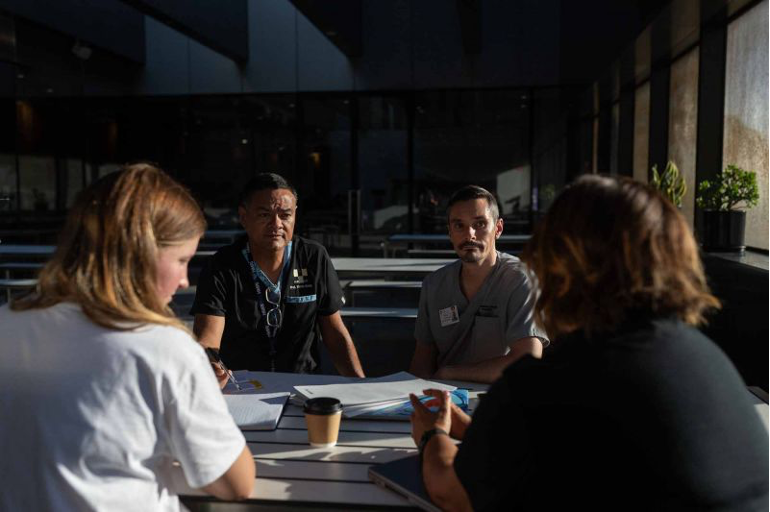
‘Philanthropy, Our Way’ makes key several recommendations around stronger cultural governance, better reporting, and long-term, trust-based partnerships that prioritise community defined outcomes.
Universities are in a unique position to model best practice by embedding Indigenous leadership and enabling more direct collaboration between funders and Aboriginal and Torres Strait Islander communities, according to Pro Vice-Chanceller Indigenous Strategy and Leadership, Loren Collyer.
“This paper speaks to the opportunity for philanthropic investment to operate – not simply as an act of giving, but as a commitment to equity, justice, and long-term partnership,” Mrs Collyer said.
While the paper highlights the opportunity available in higher education, it is clear this rhetoric can be applied to all philanthropic fields.
“When funders invest in Indigenous-led initiatives, they are supporting more than access to learning – they are enabling communities to lead their own futures, define success on their own terms, and generate solutions with far-reaching social and economic impact,” Loren Collyer said.
The authors urge funders to take action now
Noble Ambition, a philanthropy and fundraising advisory firm has been engaged to co-author the paper and brought a strong sector lens to the work.
Despite significant investment in higher education, there remains a persistent gap in funding directed to Aboriginal and Torres Strait Islander-led initiatives, according to Noble Ambition CEO, Melissa Smith.
“If our systems are not ready, the opportunity will not reach communities in the ways it needs to and should. We need funding models that move at the speed communities need, centre Aboriginal and Torres Strait Islander leadership and lived experience, and invest in genuine, long-term partnerships built on trust,” Ms Smith said.
An event will be held at the University of Newcastle’s Wollotuka Institute to mark the launch of the paper.
It will be an opportunity to hear from those behind ‘Philanthropy, Our Way’ and connect with other key partners who support Aboriginal and Torres Strait Islander‑led approaches in higher education.