Health funding fails to properly support communities
Rural Australians – including many Indigenous communities – are missing out on more than $1,000 per person in health funding every year compared to city residents, according to a new report from the National Rural Health Alliance (NRHA).
The Forgotten Health Spend: A Report on the Expenditure Deficit in Rural Australia estimates an annual underinvestment of $8.35 billion in government-funded healthcare, aged care, disability and pharmaceutical services for rural, regional and remote Australians.
“The underspend is felt sorely in GP and primary care clinics, maternity services, hospitals, mental health clinics, disability and aged care services across rural Australia,” NRHA Chief Executive Susi Tegen said on Croakey Health Media.
Health risk factors greater
The report, produced by the Nous Group, identifies Aboriginal Community Controlled Health Organisations (ACCHOs) as essential providers of “culturally safe comprehensive primary healthcare services,” particularly in the most remote areas where mainstream services are thin or absent.
While it notes that per capita expenditure on Indigenous primary healthcare increases with remoteness, there is a dip in per capita funding in many regions, which include many small rural towns, suggesting that service availability in these areas lags behind both metropolitan and more remote areas.
Aboriginal Community Controlled Health Organisations are “deeply embedded” in the communities they serve and are seen as effective.
But health risk factors, including smoking and alcohol use are greater, contributing to poorer health outcomes.
In major cities, daily smoking rates are around seven per cent. In remote and very remote areas, they rise to 20.4 per cent.
Completion of Year 12 drops from 78 per cent in major cities to around 59-62 percent in rural and remote regions.
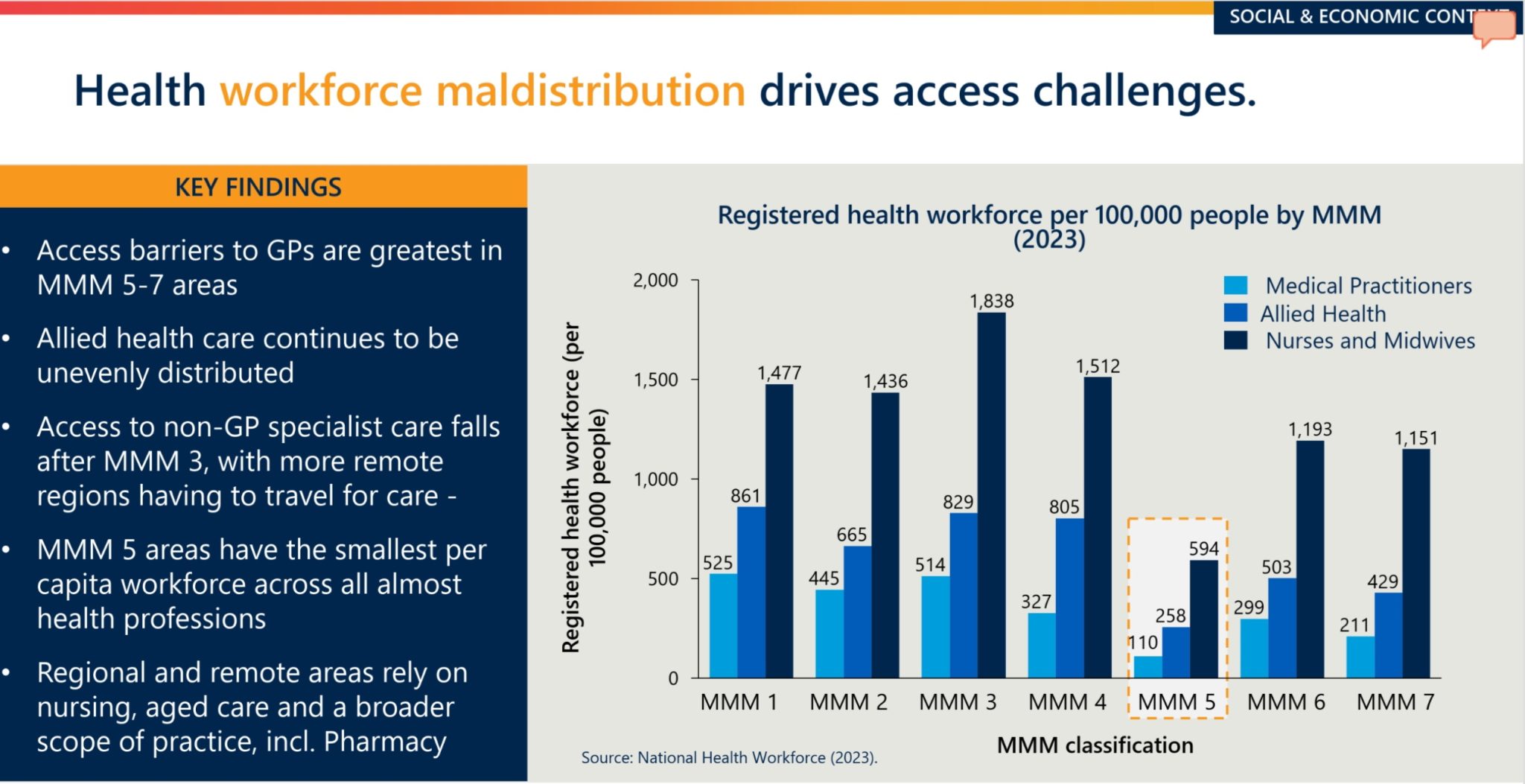
The report identifies the need to define was ‘reasonable access’ to good health care means, establish regional governance structures and use specific and deliberate delivery models.
And there has been a call to reform funding as in some regional and remote areas local councils air having to step in to fund services.
“Just because we rely on rural Australians economically to live in the regions, doesn’t mean that it is okay to underfund and underserve,” Ms Tegen said.
“We need to act now to ensure the premature death and higher illness rates stop.”